
Written by Chloee Blair
May 17, 2026
Heather Lane Neville’s got fire.
She runs her own land planning company from a bar stool over at Black Fly - what she calls her office away from home.
She’s campaigning for a county commission seat.
And she’s also the go-to for getting bike paths pushed across St. Johns County - a 17-year journey that’s finally on its way to done.
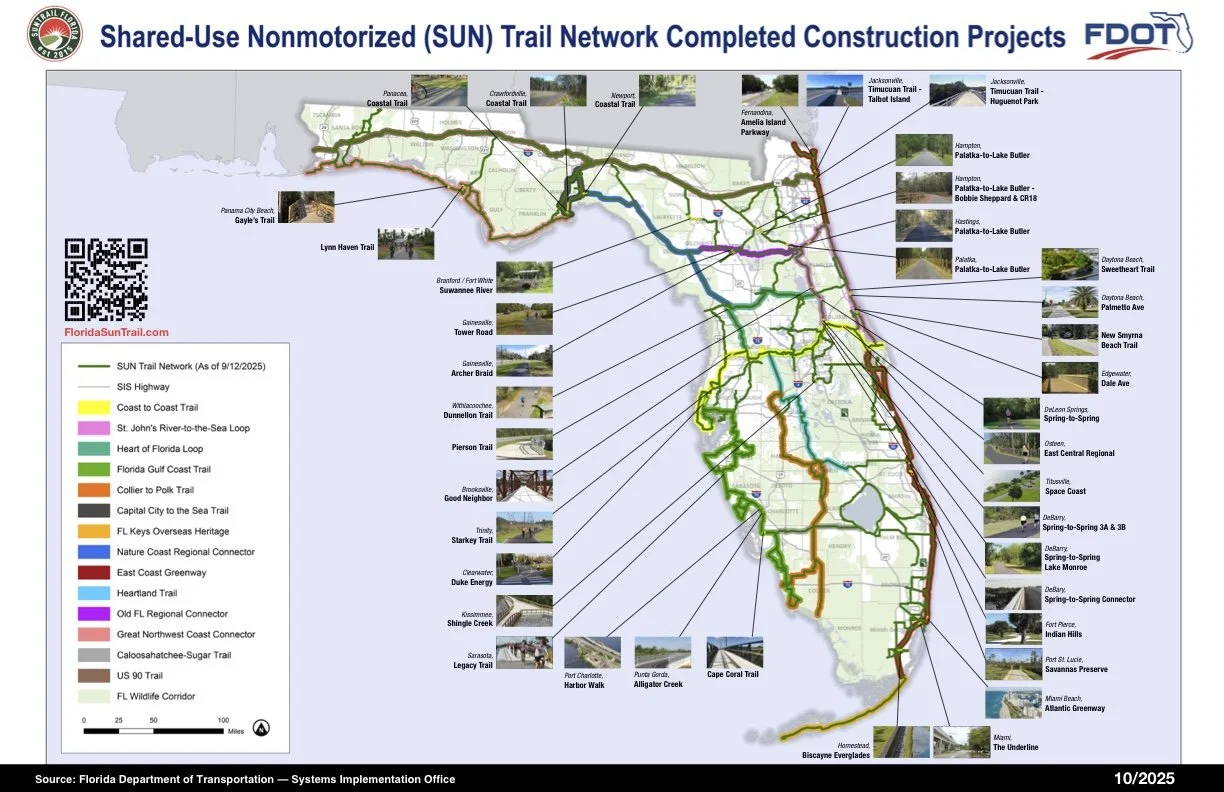
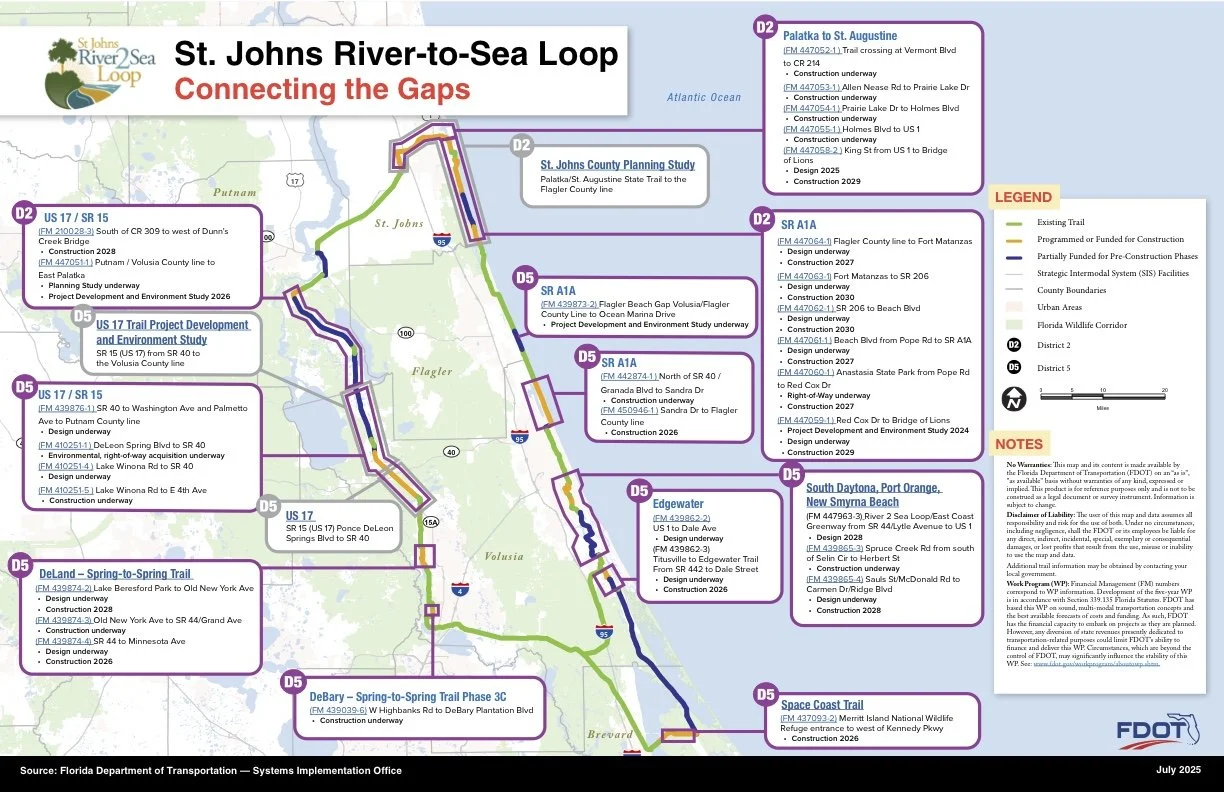
Heather is the advocate behind 13 bike-ped path projects – 32 miles of trails called the St. Johns County SUN Trail – that will connect St. Augustine to the River-to-Sea Loop – an extensive trail system that will connect St. Augustine to Ponte Vedra, Palatka, Palm Coast and beyond.
“It’s really cool. It’s a pivotal moment and when it’s done, it’s going to be rad,” she says. “It’s a win win win everywhere.”
It ain’t cheap though.
What began as a $43 million project has ballooned to $70 million, due, in large part, to COVID-19-related supply chain issues, she says.
“Same project, same trail. And if we don’t do it now, it’s just going to cost that much more,” Heather explains. "Fifteen years ago, it was about $600,000 per mile. Now we’re looking at about $2.4 million per mile, and that’s without having to buy real estate.”

The SUN Trail will run through West Augustine, West King, over (or possibly under) U.S. 1, through downtown and across the island, Heather explains.
She says the community has shown a ton of support, and not just bike enthusiasts.
“I’d been saying we need bike-ped trails, we need programs, we need money. I mean, this is schools and neighborhoods and connectivity and environmental and livability,” Heather says. “Even the horse community came out. It wasn’t just the bike community, it wasn’t just the running community – it was – we want to be able to walk to school. It wasn’t just the city, it was people living in these big neighborhoods all over the county.”
She met one of the idea people behind the Loop - Herb Miller - at a Rotary luncheon in downtown St. Augustine in 2007.
“I went to lunch and here’s this man talking about this vision,” she says. “He was such a storyteller and so engaging, you just jump on the train – he was the conductor and I’m just here to help. He always found people like that. He was a really exquisite guy.”
“I picked up the torch. The River-to-Sea Loop had a lot of momentum in other counties, but not St. Johns,” she says, explaining the paths ended here. “It was called the Trail to Nowhere.”
After discovering that neither the state nor the county had funding for bike trails, she says she learned about planning, design and engineering on-the-go.
“I started getting really good at communicating with all of these agencies, learning where the money came from and who dictates the projects,” she says.
She recounts it took 10 years to bring county and state together, finally winning a grant to do a planning study. Maneuvering between county, city and state, she managed to sell the idea of developing 32 miles of trails by “bust[ing] it up” into 1- to 3-mile segments, she explains.
“I wrote 13 grants,” she says, which won full funding. “It was 5-0 votes every time.”
Despite widespread support for the bike path projects, there’s a handful of dissenters off A1A who oppose the project in that area.

Flyer created by residents opposing the bike trails. Credit: St. Johns Citizen
“I’ve been at this for 17 years and now we’re here and about to build this thing and it’s shocking to walk into a room, into a group and be screamed at, told I’m a liar and ‘full of shit’ over a bike safety trail,” she says. “It was confusing. It’s like - what’s the lie? What are we lying about?”
She believes the push-back is primarily driven by resistance to change and residents’ reluctance to the temporary construction that will take place. But she says the project is going to improve the area for cyclists, pedestrians and residents alike.
“It’s going to move the curb out into the road by 8 feet,” she explains, which will give residents a clear line of site when exiting from their neighborhood into traffic - something they don’t currently have.
“You’re going to get speed reduction out of it, too,” she says, as the curb will narrow the road.
“If you’re going to fix something, you have to fix it,” she explains. “You have to be comfortable with being uncomfortable for 3 to 6 months.”
She also says dissenters argue it’s a waste of taxpayer dollars.
“It’s a piece of public infrastructure that won’t have to be touched for at least 50 years. It’s an improvement over what’s there now. It’ll have drainage, lighting, grass and landscaping,” she says. She also emphasizes they already have the right-of-way and no trees will be removed.
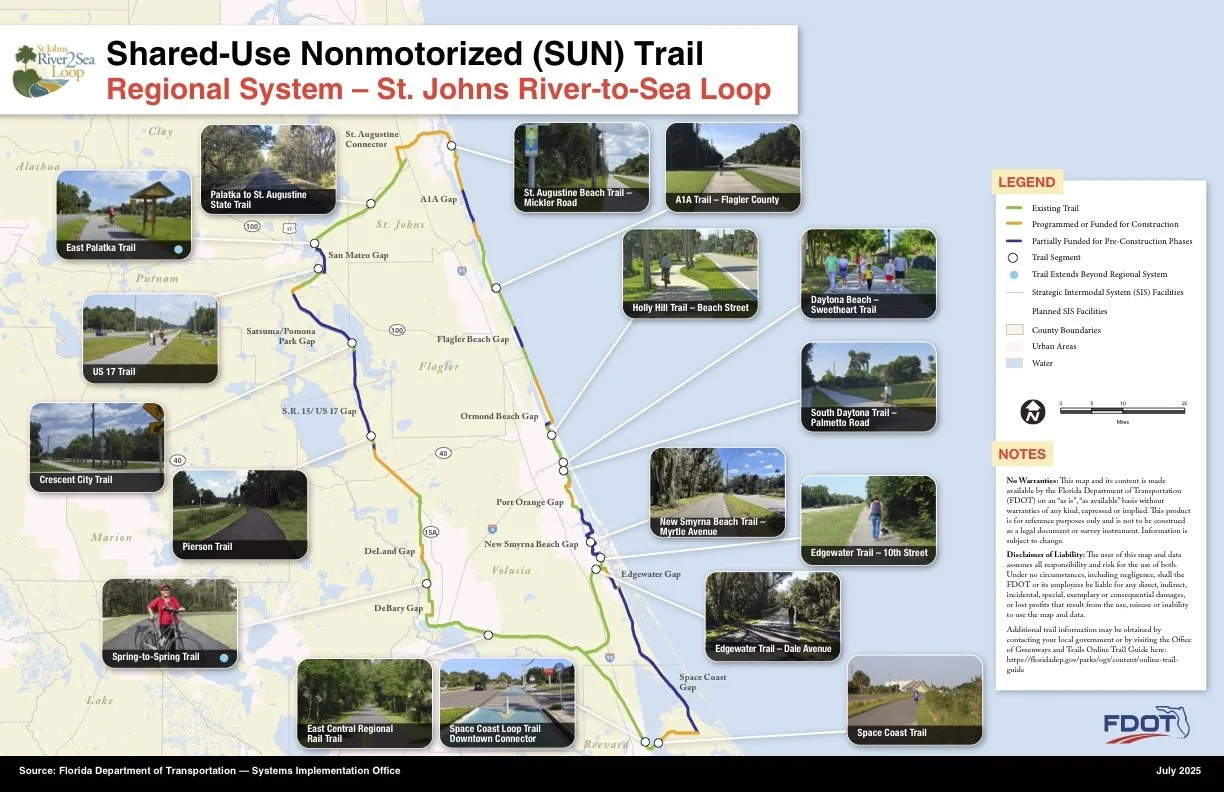
“The River-to-Sea Loop, when it’s finished - because it will be finished, it’s not going to stop - will be 260 miles. It’ll be a continuous loop. You’ll be able get on it and go town to town,” she says, comparing the Loop to an interstate, a safe “known entity” with consistent signage that connects communities.
When asked by the county why she referred to the trails as the River-to-Sea Loop, she explained that’s what it had always been called.
“I told them we can call it whatever we want and if you guys really want to call it something else, you can call it Heather’s Way,” she says, laughing. “Or Heather’s Path, since I guess, at this point, it’s my life path.”
Check out St. John’s County SUN Trail site for more info.